
Correlating early-appearing medical imaging changes with variable RBE-based dose calculations for establishing an adaptive proton therapy strategy
- Planned secondments: Siemens Healthineers (Germany), Stockholm University (Sweden) and Aarhus University (Denmark)
- PhD program: University of Navarra, Department of Physics and Applied Mathematics
Project description
There is growing evidence of unexpected imaging changes and toxicity related to proton therapy (PT) treatments. These data suggest a complex radiobiological behavior that could be better predicted using models for variable relative biological effectiveness (RBE). These models have not been incorporated yet to routine clinical practice. It is worth investigating the correlation between prediction and clinical outcomes, determine which RBE model should be preferred, and seek image biomarkers to anticipate such a response. Our hypothesis is that image changes and toxicity can be observed early in the patient response to the treatment, using MRI or CT depending on the treatment site. A strategy could be defined to adapt the plan during the last part of a typical PT treatment course of 3-5 weeks.
This project aims to assess the best variable RBE model to predict these image changes and toxicity. In central nervous system (CNS) tumors, several RBE models will be used to retrospectively calculate the biological dose distributions on a cohort of patients treated with PT where these changes have been observed in our Institution. We will propose for future patients to acquire a reference MRI scan before the treatment, one more during the treatment (week #4), and others during patient follow-up after treatment completion to identify image changes. Understanding the image formation processes will allow us to seek an MRI sequence and marker which could be related to the biological dose distribution.
In the case of lung tumors, changes in lung density will be observed using CT imaging and used as biomarkers which could identify a variable RBE response. We will use the planning CT, an intermediate during week #4, and the subsequent control CTs. Our aim is to relate these voxel density changes with retrospectively calculated biological dose values and define strategies for bio-adaptive PT in future patients. We will use deformable registration (DIR) to include the breathing cycle and accumulate the absorbed and biological proton doses.
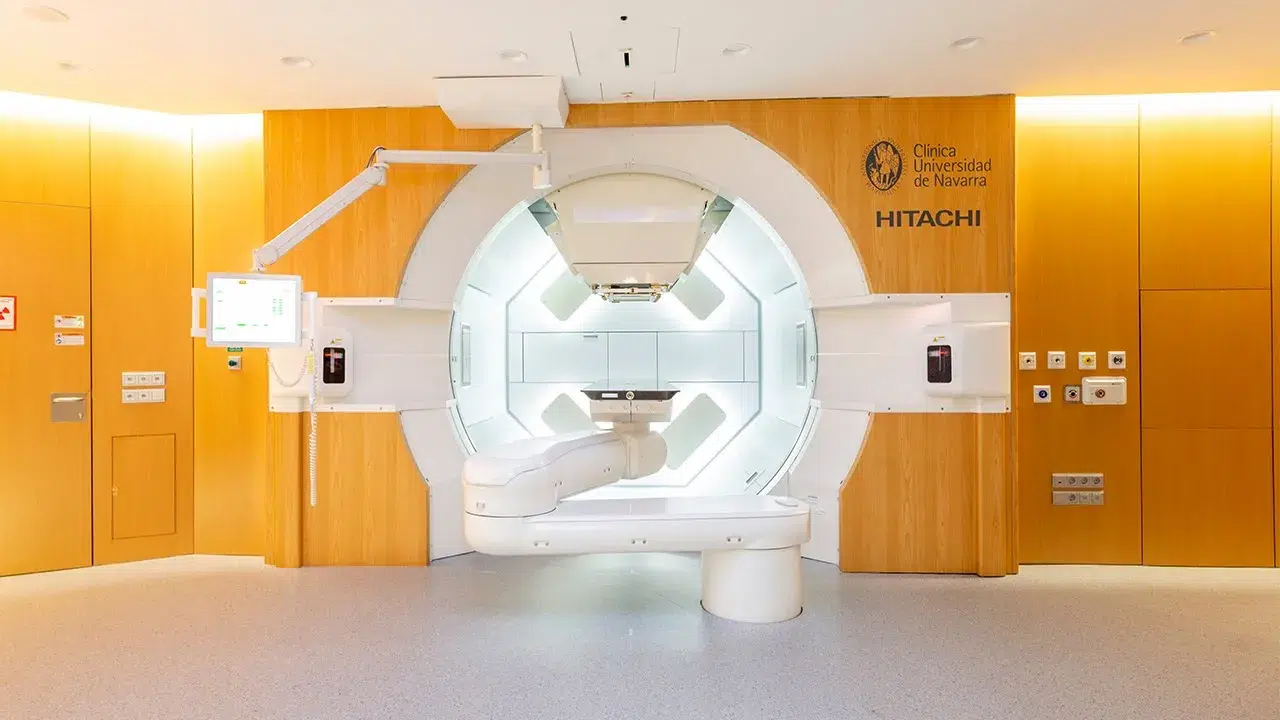
The candidate will work at the Proton Therapy Unit of Clínica Universidad de Navarra (CUN), which is located in Madrid, and be part of the research group of Medical Physics and Biophysics in Pamplona.
For more information concerning the research project please contact:
Juan Diego Azcona and Javier Burguete

Candidate profile
Doctoral Candidate at University of Navarra
The candidate should have:
- Master’s degree on Physics or Medical Physics or related disciplines
- Knowledge on the physics of interaction of radiation with matter
- Strong computer programming skills
- Knowledge of the radiation therapy environment and medical imaging processing is a plus
- Motivated and pro-active attitude
- Ability to work in an interdisciplinary environment
- Good scientific communication skills
- Ability to team up with peers to pursue a common goal
- Fluent in spoken and written English

University of Navarra
PROJECT BENEFICIARY
University of Navarra (UNAV) includes the Clínica Universidad de Navarra (CUN), a non-profit, world-class general hospital. CUN’s clinical model integrates patient care, research and lecturing. All the professionals involved in cancer diagnosis, treatment, and research in CUN, as well as researchers in UNAV, are integrated into a Comprehensive Cancer Center (CCUN). CUN proton therapy facility is located in Madrid, it is currently one of the two Institutions providing proton therapy in Spain, treating patients both from Spain and abroad.
Research in Medical Physics is mainly focused on x-ray and proton radiotherapy: dose calculation methods, motion management, image processing, adaptive radiation therapy, physics and technology of proton beam therapy, microdosimetry and radiobiology. The Research Group of Medical Physics and Biophysics integrates researchers from the Service of Medical Physics in CUN, and from the Department of Physics and Applied Mathematics in the School of Sciences, UNAV.