
5D model-based treatment personalization for right-time adaptive proton therapy
- Planned secondments: Holland PTC (The Netherlands), University of Ljubljana (Slovenia) and Cosylab (Slovenia)
- PhD program: Katholieke Universiteit Leuven
Project description
RAPTORplus aims at adapting proton therapy treatment with multi-modality image information acquired at various time scales. Daily anatomical changes would be characterized by on-board X-ray based imaging systems (or eventually MRI), while longer term biological modifications would be detected with offline functional imaging (PET or MRI). The optimal timing of image acquisition and subsequent adaptations depend on the potential gains in outcome which must be balanced against practical considerations. For instance, it might be more productive to develop very fast treatment workflows without online adaptation to maximize patient throughput on an expensive proton therapy machine, instead of performing systematic online adaptation with minor gains in clinical outcome and a reduction in machine capacity due to the time required for the adaptation. The opensource treatment planning system (OpenTPS) will be extended to optimize and/or evaluate a treatment using multi-modality image information (3 first dimensions), timing considerations (4th dimension), and biological modeling (5th dimension). Variability in treatment outcome will be expressed using normal tissue complication and tumor control probabilities. Treatments with X-rays and protons will be both simulated.
We provide here a more detailed description of the workpackages (WP) associated to this project
WP1 – Development of a flexible clinical workflow simulator in OpenTPS: OpenTPS features an advanced robustness evaluation tool for proton therapy treatments (MCsquare), including LET computation. OpenTPS will also soon feature photon dose calculation. By introducing multi-modality imaging, treatment adaptations on various timescales, and, when necessary, biological functions (TCP and NTCP), it would be possible to provide a comprehensive and quantitative assessment of the treatment outcome for many adaptation, fractionation, and treatment prescription schemes.
WP2 – Optimization of the treatment workflow using various optimization techniques: We will first envisage optimization techniques that are not based on neural networks. We will first optimize the workflow against physical parameters (dose distribution related metrics) before integrating biological functions.
WP3 – Training of an AI-agent with reinforcement learning: In this case, an AI-agent, whose task will be to “discover” the best treatment strategy, will be trained with reinforcement learning. The reward can be formulated as the product of the TCP x (1 – NCTP). The AI-agent will then play with the meta-parameters in order to maximize that product.
The Doctoral candidate will work at the Laboratory of Experimental Radiotherapy in the Department of Oncology under the supervision of Prof. Edmond Sterpin.
For more information concerning the research project please contact:
Edmond Sterpin

Candidate profile
Doctoral Candidate at KU Leuven
The candidate should:
- Be interested in an intensive research experience of several years
- Have a strong scientific background: master in physics, master in medical physics and many masters engineering are eligible (physics, computing, signal processing,…)
- Strong skills in scientific programming: knowledge of Python and C/C++
- Strong oral and written communication skills in English
- Be open to travel, as secondments are foreseen

KU Leuven
PROJECT BENEFICIARY
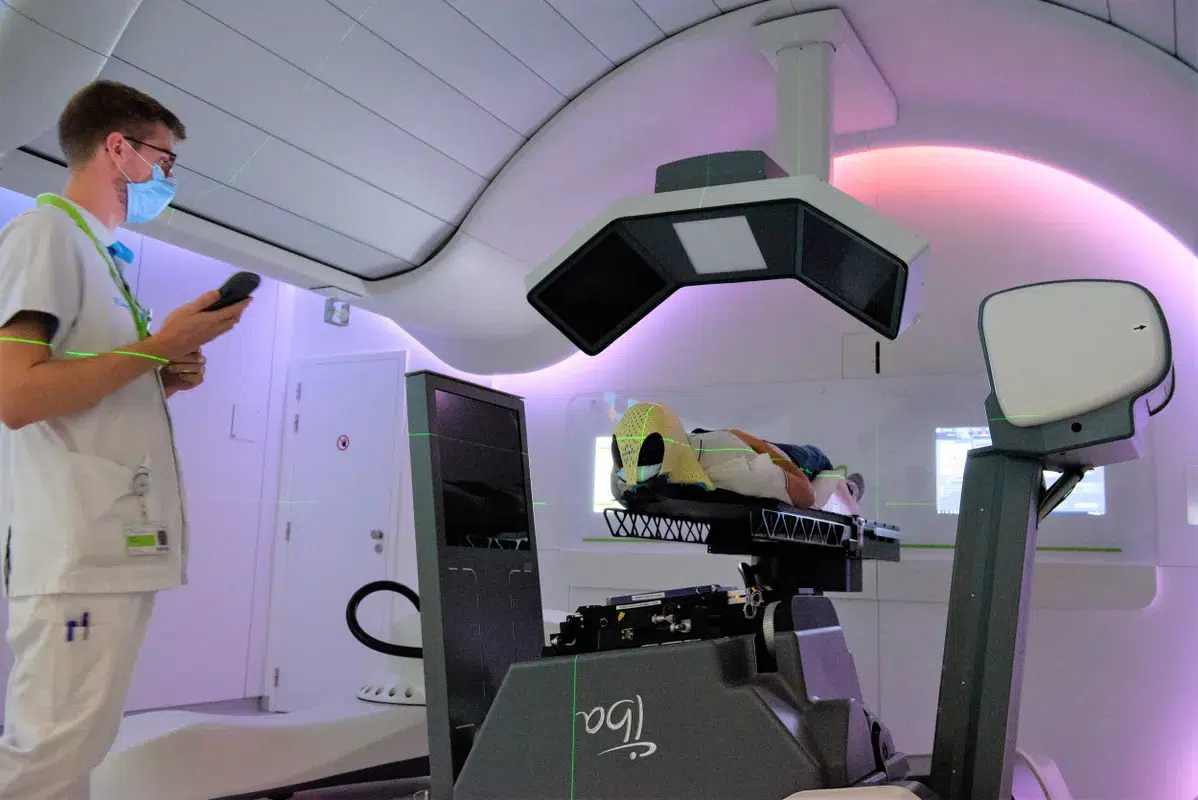
KU Leuven is currently by far the largest university in Belgium in terms of research funding and expenditure (EUR 740 million in 2023), and is a charter member of League of European Research Universities (LERU). The proton center is fully integrated within the existing academic hospital. The center encompasses two vaults, with their own accelerator: one for the treatment of patients and one dedicated vault for research purposes. A Proteus®ONE system capable of pencil beam scanning is installed with the full scope of imaging modalities (kV-kV, CBCT), including an in-room dual energy CT on-rails.